DesignPatterns Factory
https://www.youtube.com/watch?v=EdFq_JIThqM
origin
- donnot have a common base class
1 | |
We can extract common foods then have a standard factory below.
It extracts common methods from the BeefBurger and VeggieBurger classes, reducing duplicated methods.
Static Factory Method (Simple Factory)
is not a full-fledged offical pattern
- Implementation
Uses a single class with a static method to create different types of objects based on input parameters. - Use Case
Use the Simple Factory pattern when you have a limited number of classes to instantiate and do not expect the set of classes to change frequently.
UML
classDiagram
    class Restaurant{
        + Burger orderBurger()
    }

    class SimpleBurgetFactory{
        + Burger createBurget()
    }

  class Burger {
      + int productId
    + String addOns
    + prepare()
  }

  class BeefBurger {
      + boolean angus
    + prepare()
  }

  class VeggieBurger {
      + boolean combo
    + prepare()
  }

Burger  <|--  BeefBurger
Burger  <|--  VeggieBurger
Burger  <.. SimpleBurgetFactory
SimpleBurgetFactory <.. Restaurant
implements
1 | |
Factory method
https://refactoring.guru/design-patterns/factory-method
“When we need to add a new recipe, we still need to change SimpleBurgetFactory code.”
工厂方法模式 : 只创建一种类型的实例,
抽象工厂方法模式 : 创建多种类型的实例, 抽象工厂 只有一个实例后,也就是工厂方法。

工厂方法和抽象工厂方法 都是通过工厂生产产品,由于产品都实现了相同的接口,根据获取到的产品作相应的处理
工厂方法 :返回一个产品实例 , 继承了工厂Dialog Base类,Base类抽象方法由sub类实现
抽象工厂方法:可以返回一组相关的产品实例,实现了创建不同产品的抽象工厂接口
工厂方法,一个工厂对应一个产品.
如果我们想新增一种类型或者修改,一种类型,那么就需要修改上面简单工厂的代码。
Standard UML
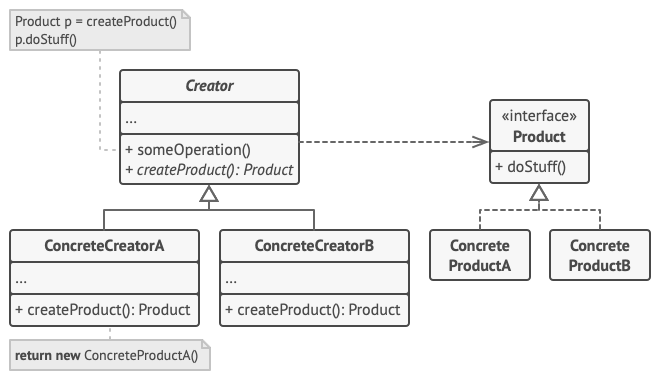
classDiagram
  class Creator {
      + someOperation()
    + factoryMethod(): Product
  }

  class ConcreteFactoryA {
    +createProduct(): Product
  }

  class ConcreteFactoryB {
    +createProduct(): Product
  }

  class Product {
    <<interface>>
    +operation(): void
  }

  class ConcreteProductA {
  }

  class ConcreteProductB {
  }

  Creator ..> Product : Dependency

  Product <|-- ConcreteProductA : Inheritance
  Product <|-- ConcreteProductB : Inheritance
  Creator <|.. ConcreteFactoryA : Realization
  Creator <|.. ConcreteFactoryB : Realization
我们的工厂不再创造对象,而是把这个构建过程移到子类。
UML IMPLEMENTATION
classDiagram
  class Restaurant {
    + someOperation()
    + factoryMethod(): Burger
  }

  class BeefBurgetRestaurant {
    +createProduct(): Burger
  }

  class VeggieBurgetRestaurant {
    +createProduct(): Burger
  }

  class Burger {
    <<interface>>
    +prepare(): void
  }

  class BeefBurger {
  }

  class VeggieBurger {
  }

  Restaurant ..> Burger : Dependency
  Restaurant <|-- BeefBurgetRestaurant : Inheritance
  Restaurant <|-- VeggieBurgetRestaurant : Inheritance
  Burger <|.. BeefBurger : Realization
  Burger <|.. VeggieBurger : Realization
1 | |
JDK源码解析-Collection.iterator方法
ArrayList used

11f207f50a613801f673fd4c82242b3c35d71f4b
Collection接口 : 抽象工厂类, Restaurant
ArrayList : 具体的工厂类; BeefBurgetRestaurant
Iterator接口是抽象商品类, Burger
ArrayList类中的Iter内部类 : 具体的商品类。 BeefBurger
在具体的工厂类中iterator()方法创建具体的商品类的对象。
1 | |
另外
DateForamt类中的getInstance()方法使用的是工厂模式;
Calendar类中的getInstance()方法使用的是工厂模式;
The problem of Factory of method
如果我们需要新开另一家店 italian 餐厅,由于当前的工厂只能生产一种产品,所以就需要在工厂里面添加参数判断,这样使用工厂方法,还是比较耦合。
Demo1
1 | |
Demo2
The first picture is the factory method
But if we want to buy a new type of product, the code will look like this, the same as in demo1.

that violate the open-closed principle
How can we solve the problem?
Abstract Factory
在原有生产GPU的产品线上,好需要添加监控的功能,此时就会出现如下 代码耦合的情况。
https://www.youtube.com/watch?v=QNpwWkdFvgQ&t=0s
Use Case:
- Use the Abstract Factory pattern when a system needs to be independent of how its objects are created, composed, and represented.
- It is useful when a system needs to support multiple families of products.
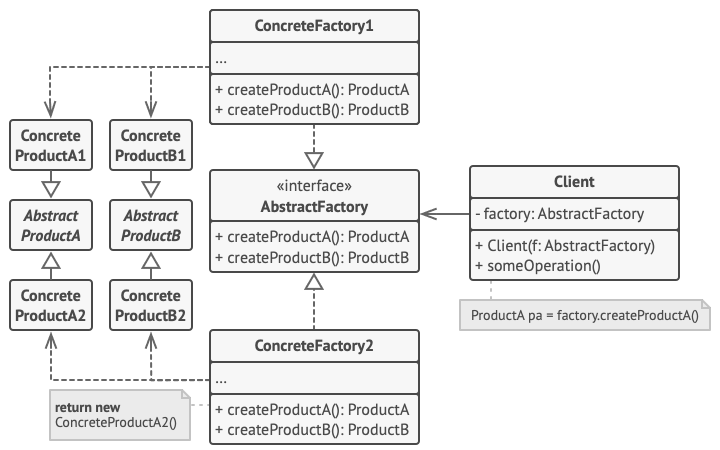
Implementation:
- so A single factory is not enough,
The Abstract Factory pattern involves multiple factory methods to create a set of related objects. - It defines an interface for creating all the objects in a family, and each concrete factory implements this interface to create specific types of objects.

The class I drew below is not very clear, so I only drew the ConcreateFactory part
classDiagram
  class AbstractFactory {
    +createProductA(): AbstractProductA
    +createProductB(): AbstractProductB
  }

  class ConcreteFactory1 {
    +createProductA(): AbstractProductA
    +createProductB(): AbstractProductB
  }

  class ConcreteFactory2 {
    +createProductA(): AbstractProductA
    +createProductB(): AbstractProductB
  }

  class AbstractProductA {
    +operationA(): void
  }

  class ConcreteProductA1 {
    +operationA(): void
  }

  class ConcreteProductA2 {
    +operationA(): void
  }

  class AbstractProductB {
    +operationB(): void
  }

  class ConcreteProductB1 {
    +operationB(): void
  }

  class ConcreteProductB2 {
    +operationB(): void
  }

  AbstractFactory <|-- ConcreteFactory1
  AbstractFactory <|-- ConcreteFactory2
  AbstractProductA <|..ConcreteProductA1
  AbstractProductA <|..ConcreteProductA2
  AbstractProductB <|..ConcreteProductB1
  AbstractProductB <|..ConcreteProductB2

  ConcreteFactory1 *.. ConcreteProductA1
  ConcreteFactory1 *.. ConcreteProductB1
implements

1 | |
Summary of Differences
- Scope: The Factory Method is used for creating a single product, while the Abstract Factory is used for creating families of related products.
- Complexity: The Abstract Factory pattern is more complex than the Factory Method pattern because it involves multiple factory methods to create a set of related objects.
- Inheritance vs. Composition: The Factory Method pattern uses inheritance to let subclasses decide which class to instantiate, while the Abstract Factory pattern uses composition to create families of related objects. but I think I think there isn’t much difference.
https://blog.csdn.net/qq_18242391/article/details/81503370
https://github.com/geekific-official/geekific-youtube/blob/main/design-patterns/creational-abstract-factory/src/main/java/com/youtube/geekific/MainApp.java